Battery Update

News from our battery research team

In the Battery Update, researchers from Fraunhofer ISI discuss current debates and issues related to battery research, production and development. Along the entire battery value chain, i.e. from raw materials, components, the battery cell, battery markets and recycling, relevant topics are adressed and critically discussed.

On this page we collect all articles of our Battery Update. You can also subscribe to the Battery Update via RSS feed.

You can find interesting articles on other scientific topics in the Fraunhofer ISI blog. Fraunhofer ISI' Battery Update is registered with the German National Library under ISSN 3054-5579.

Cancel
  • Installed and announced (maximum) recycling capacity in Europe compared with forecast return volumes (EoL and production scrap) – status October 2026
    © Fraunhofer ISI

    Lithium-ion battery recycling in Europe is currently continuing to expand, though it has also experienced several setbacks over the past two years. Nevertheless, recycling remains an essential element for the future battery ecosystem in Europe. As an update to an article from July 2025, this blog post examines the latest developments.

    more info
  • Additional value creation, employment effects, and investments resulting from the CCVR and IAA compared with the baseline scenario.
    © Fraunhofer ISI

    The proposed EU regulations IAA and CCVR could significantly strengthen the production of electric vehicles and key components in Europe. A modeling study by Fraunhofer ISI shows that by 2035, these measures could generate an additional €23–25 billion in annual value creation in Europe and positive employment effects equivalent to more than 320,000 full-time positions. The decisive factor is not so much additional demand for electric vehicles, but rather where vehicles and batteries are produced.

    more info
  • Funding volumes and research priorities in Li-S research
    © Fraunhofer ISI

    Lithium-sulfur batteries are considered a promising high-energy technology, but have not yet been broadly commercialized. A look at start-ups, industrial activity and publicly funded research projects shows where the technology stands today. The next market opportunities are likely to emerge less in mass-market applications than in niches with particularly high requirements for battery weight.

    more info
  • Lithium Production 2020-2030
    © Fraunhofer ISI

    The global supply of essential raw materials for battery production is closely linked to geopolitical dependencies and the market dominance of individual global companies. The focus is particularly on market structures, geopolitical influences, production capacities and security of supply.

    more info
  • Comparison of support measures for BEV in selected countries
    © Fraunhofer ISI

    Support programs and strategies vary greatly in some cases when compared internationally. This blog post compares initiatives by leading industrial nations to promote electric mobility. Of particular interest are the different approaches taken by countries to support industry, which are categorized into three dimensions: market incentives, charging infrastructure, and the future of the combustion engine.

    more info
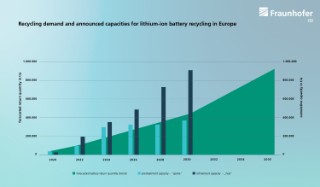
  • Recycling demand and announced capacities for lithium-ion battery recycling in Europe
    © Fraunhofer ISI

    The recycling of lithium-ion batteries (LIB) will play a key role for Europe in order to gain ac-cess to strategic raw materials. In addition to scale up existing pilot projects, announcements of new plants and the cancelling of recycling projects have been observed for around a year. This blog post provides an update on an article from August 2024 and discusses the latest developments.

    more info
  • Mini- and Microenvironments in Battery Cell Production: Players, Patents and Potential

    by Claresta Rugerri and Christoph Neef / June 02, 2025

    Map with actors from the fields of drying technology, clean and dry rooms, glovebox.
    © Fraunhofer ISI

    Mini- and microenvironments have the potential to make battery cell production more sustainable. These concepts are still a research topic. However, industrial activities are also increasing, with many of the players coming from Germany and Europe. An analysis of patent activities and players shows the research hot spots and geographical hot spots of this emerging technology.

    more info
  • Forecasting the ramp-up of battery cell production in Europe: A risk assessment model

    by Tim Wicke, Lukas Weymann, and Christoph Neef / April 28, 2025

    Battery production capacities in Europe: Delayed and failed projects
    © Fraunhofer ISI

    Announced production capacities in Europe amount to more than two terawatt hours per year by 2030. This exceeds the expected demand. In addition, recent years have shown that it is very unlikely that all announced projects will be realised. For this reason, Fraunhofer ISI has developed a methodology that can be used to determine the probability of realisation of battery production announcements with an assessment of the likelihood of implementation for battery production projects.

    more info
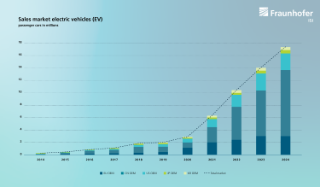
  • Electric car sales figures: temporary weakness or turnaround?

    by Philipp Keller and Tim Wicke / October 24, 2024

    Estimated ramp-up of BEV sales in Europe by 2030 based on the sales targets set by manufacturers
    © Fraunhofer ISI

    In recent months, there have been repeated reports of low sales figures for electric cars and redundancies at car manufacturers due to underutilized production lines. The following analysis provides an overview of the current situation on the vehicle market in Germany and Europe.

    more info
  • Der European Battery Business Club (EBBC) vermittelt aktuelles Batteriewissen in Kombination mit Einblicken in die Industrie durch ein asynchrones Online-Training.
    © EBBC/Fraunhofer ISI

    As the battery industry continues to expand, the need for specialized training and upskilling becomes imperative. In this article, we will explore the different groups within the industry that require vocational training and examine the suitability of pure online trainings. The European Battery Business (EBBC) addresses these needs by providing cutting-edge battery knowledge with industry insights, delivered through innovative micro-learning elements. This ensures self-directed learning and the possibility to educate a high number of personnel at the same time. Does the format and the content of the EBBC fit to the training needs of the growing European battery technology industry?

    more info
  • Solid-state batteries for electric vehicles: Still in R&D or on the verge of commercialization?

    by Inés Rosellón Inclán and Christoph Neef / April 30, 2024

    Solid-state batteries: Publications by origin and announced cell production capacities by planned location
    © Fraunhofer ISI

    Solid-state batteries (SSBs) have gained in importance in recent years and almost all well-known OEMs mention the technology on their development roadmaps, sometimes with quite specific dates for their implementation. But have SSBs already reached the necessary technological maturity for introduction in the automotive market? Alongside the manufacturers' commercialization announcements, there are still reports from research and development that suggest that there are still major challenges on the road to mass production.

    more info
  • Comparison of alternative battery technologies: technology maturity, market potential and sustainability benefits
    © Fraunhofer ISI

    The growing global demand for batteries is currently covered for the largest part by lithium-ion batteries. However, alternative battery technologies are increasingly coming into focus due to geopolitical dependencies and resource availability. What alternatives to lithium-ion batteries can meet the growing demand, ease the raw material situation and reduce geopolitical dependencies? How can supply chains be established in such a way that a resilient and technologically sovereign battery ecosystem can be created in Europe? And what about sodium-ion batteries, already used in electric vehicles in Asia?

    more info
  • Solid-state battery roadmap with different cell concepts and their expected start of industrial pilot production
    © Adapted from Thomas Schmaltz, Felix Hartmann, Tim Wicke, Lukas Weymann, Christoph Neef and Jürgen Janek (2023): A Roadmap for Solid-State Batteries; in: Advanced Energy Materials (Volume 13, Issue 43/2023) published by Wiley-VCH GmbH

    Solid-state batteries are regarded as a promising further development of lithium-ion batteries. Different materials are available for the various components. Which ones could be successfully commercialized in (hybrid) cell concepts in the future?

    more info