Project

SQuaD – Umbrella Project Quantum Communication Germany

The central aim of the Umbrella Project Quantum Communication Germany (SQuaD) is to promote the coherent development of quantum communication (Qcom), to act as a platform for all relevant partners from Germany and thus to secure a strong role for Germany and Europe in the commercialisation of Qcom. In this way, synergies will be leveraged, duplication avoided and the optimal utilisation of resources from research and industry ensured, thus significantly strengthening the competitive position in the international environment and securing technological sovereignty in the long term.

The participation of relevant national institutes enables the independent characterisation of hardware components and the early consideration of security aspects. International networking as well as monitoring and roadmapping activities support the strategic orientation of the umbrella and optimise the German position in Qcom.

Quantum communication offers new possibilities for more precise time synchronisation, blind cloud computing and highly secure data transmission. QKD, quantum-based key distribution, is a promising part of quantum cryptography that can enable a qualitatively new level of eavesdropping security. Technologies in this area are about to be launched on the market and are considered part of the solution for quantum-safe cryptography.

The SquaD umbrella project aims to promote the development of quantum communication in Germany and serve as a platform for all relevant partners. This will strengthen the competitive position of Germany and Europe, utilise synergies and make efficient use of resources in order to secure technological sovereignty in the long term.

The tasks of Fraunhofer ISI in the SQuaD project include:

Monitoring

A qualitative trend analysis will analyse the current status and future developments in Qcom technology at national, EU-wide and international level. Relevant players will be identified and an overview of the ecosystem will be provided. Quantitative benchmarking will analyse publications, patents, applications and markets in the field of Qcom in Germany, the EU and worldwide in order to enable a neutral comparison of activities.

Roadmapping

Based on the findings from the previous analyses, technology roadmapping processes are carried out to identify future developments and challenges. The aim is to focus on specific technologies and areas of Qcom. The processes include a detailed analysis of the focal areas in relation to the state of the art, relevant players and future developments.

In addition, an application roadmap will be drawn up to identify the potential and requirements of Qcom in various application areas. This involves analysing questions relating to possible applications, the added value of Qcom, economic aspects, interfaces to existing systems and effects on the area of application.

Monitoring Report 2 – Quantum Communication 2026

Monitoring Report 2 – Quantum Communication
© Fraunhofer ISI

This report explores quantum communication technologies, emphasizing their role in securing communications against quantum computing threats. It categorizes these technologies into three generations: 1) prepare-and-measure QKD (market-ready but costly); 2) entanglement-based QKD (promising but less mature); and 3) quantum repeaters (essential for long-distance applications but still in development). The analysis draws on recent advancements, publication trends, patents, and market projections, highlighting strong growth potential in sectors like government, defense, and finance. The report also examines challenges and strategies for achieving technological sovereignty, including funding and standardization. It underscores the strategic importance of quantum communication for security and economic competitiveness.

Download Report

Monitoring Report 1 – Quantum Communication 2024

Monitoring Report 1 – Quantum Communication 2024
© Fraunhofer ISI

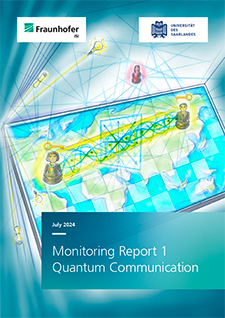
Due to advances in quantum computing,  “quantum-safe” encryption methods will be needed in the future to ensure secure communication. Quantum communication could play a crucial role in this. This report gives an overview of the three generations of quantum communication technologies: quantum key distribution following the prepare & measure principle, entanglement-based quantum key distribution and quantum repeaters. The report analyses the developments in research, industrialization, test infrastructure and market, and shows increasing publication and patenting activities. In addition, funding programs in Germany and Europe as well as international strategies for quantum communication are examined. Finally, challenges and measures to secure technological sovereignty in quantum communication are discussed.

Download Monitoring Report

Application Perspectives in Quantum Communication

Application Perspectives in Quantum Communication
© Fraunhofer ISI

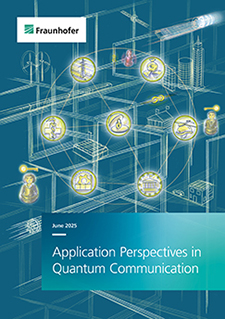
Quantum Key Distribution (QKD) is considered a promising quantum-safe cryptography technology that could ensure the long-term security of critical data. This report discusses the potential applications of QKD in various sectors, including public administration, the military and defence, banking and finance, utility providers, the medical sector, industry and the QKD service sector. It analyses the framework conditions, regulatory context and requirements for QKD adoption, providing an assessment of adoption in these sectors in the coming years. It also discusses crucial aspects of standardisation, certification and approval, as well as network aspects. Finally, the report discusses applications of quantum communication beyond QKD.

Download Report

Technology Overview and Future Perspectives

Quantum Key Distribution (QKD) enables an option for the secure transmission of confidential information and is considered a key technology for technological autonomy and sovereignty. Our technology roadmaps examine selected vital component technologies for quantum communication, in particular for QKD, and assess their innovation potential and key challenges for current and future use cases.

Quantum Repeaters

Quantum Repeaters Roadmap
© Fraunhofer ISI

With the rise of quantum technologies, quantum information and distributed entanglement could become central resources for entirely novel applications. However, since quantum states cannot be amplified due to the no-cloning theorem, new solutions are required for long-distance quantum communication – one of the most promising approaches being the quantum repeater. This report provides an overview of the current state of research and the future potential of quantum repeaters, drawing on an extensive literature review as well as the assessments of 22 experts from science and industry. It explains the relevant applications (including extending the range of QKD, interconnecting quantum processors, and distributed quantum sensing), the operating principle of iterative entanglement swapping, and the classification of different repeater types and hardware platforms – among them color centers, trapped atoms and ions, atomic ensembles, rare-earth systems, and quantum dots. Based on key performance indicators, the strengths and challenges of each platform are compared. Finally, the report presents a roadmap outlining the current state of the technology, the central challenges for further development, and future milestones on the path toward commercially viable quantum repeaters and a future quantum internet.

Download Report


Photon Detectors

Anwendungsperspektiven in der Quantenkommunikation
© Fraunhofer ISI

Single-photon detectors are the decisive component in discrete-variable QKD (DV-QKD), as their performance directly limits the secure key rate, maximum distance, and robustness against noise across fiber, free-space, and satellite links. This report focuses on Silicon Single-Photon Avalanche Diodes (Si-SPADs), Indium Gallium Arsenide/Indium Phosphide SPADs (InGaAs/InP-SPADs), and Superconducting Nanowire Single-Photon Detectors (SNSPDs). The study examines the current status, advantages and disadvantages of each technology for different QKD application scenarios. It also identifies key performance indicators, highlights challenges in technology and market adoption, and presents a roadmap for technological development from 2025 to beyond 2040.

Download Report

Light Sources

Light Sources for Quantum Key Distrubtion
© Fraunhofer ISI

Since information in QKD is encoded in the quantum states of photons, light sources are essential components of QKD systems, which cansignificantly influence their performance Although most commercially available QKD systems currently rely on mature laser-based technologies, there remains considerable room for improvement and opportunities to adopt diverse, emerging light-source technologies. This study analyzes various light source technologies, including coherent sources, photon-pair generation through Spontaneous Parametric Down-Conversion (SPDC) and Four-Wave Mixing (FWM), as well as quantum dots and other deterministic sources. It covers the key performance indicators of these light source technologies, their application in QKD, their respective levels of technological maturity, and pathways to industrialization.

Download Report

Duration

09/2022 – 12/2025

Client

    Federal Ministry of Education and Research –

    Bundesministerium für Bildung und Forschung (BMBF)

    Förderkennzeichen: 16KISQ116

Project team Fraunhofer ISI

  • Thomas Schmaltz
  • Lukas Weymann
  • Saeideh Shirinzadeh
  • Chie Endo


Network coordination

  • Physikalisch-Technische Bundesanstalt (PTB), Braunschweig
  • Bundesamt für Sicherheit in der Informationstechnik (BSI), Bonn


Partners

  • KEEQuant GmbH, Fürth
  • Quantum Business Network UG, München
  • Universität des Saarlandes (UdS), Saarbrücken
  • Fraunhofer-Institut für System- und Innovationsforschung (ISI), Karlsruhe
  • Fraunhofer-Institut für Angewandte Optik und Feinmechanik (IOF), Jena
  • Fraunhofer Heinrich-Hertz-Institut (HHI), Berlin
  • Leibniz Universität, Hannover (LUH)


Website